



Many UK property owners and site operators invest in a pan‑tilt‑zoom camera expecting full‑site coverage, yet discover critical blind spots after installation. A single PTZ surveillance camera can only point in one direction at any given time, leaving unmonitored zones when the lens pans away from entry points or high‑risk boundaries. For rural farms, commercial car parks, storage yards and large residential estates, poor coverage planning renders even high‑spec hardware ineffective for evidence capture and crime deterrence.
Under UK GDPR and ICO surveillance guidance, surveillance systems must deliver proportionate, well‑planned monitoring while avoiding unnecessary privacy intrusion onto neighbouring land. This article walks through core PTZ mechanics, real‑world deployment trade‑offs, and practical buying and installation steps. It will help you avoid common planning mistakes, select suitable hardware, and build a reliable surveillance setup matched to British site conditions.
Key Takeaways
-
PTZ means Pan, Tilt and Zoom: a mechanical PTZ can change direction and, where supported, use optical zoom to inspect distant subjects.
-
Coverage is not the same as identification: a camera may see a large area without producing enough detail to identify someone at the far end.
-
PTZ does not automatically replace fixed CCTV: when the PTZ turns towards one area, another area may no longer receive a close, continuous view.
-
Installation matters as much as specifications: mounting height, obstructions, lighting, target distance and network or power availability all affect real-world performance.
-
A hybrid system is often practical: fixed cameras can protect critical points while a PTZ provides flexible monitoring of larger open areas.
-
UK privacy requirements should be considered: particularly where a camera can capture neighbouring property, shared spaces or public areas. Check current GOV.UK guidance before installation.

What Is a Pan Tilt Zoom Camera?
What Does PTZ Stand For?
In practice, a PTZ surveillance camera might initially monitor a driveway entrance, then pan towards a side gate when movement is detected and zoom towards a vehicle. This makes PTZ particularly useful where important activity can occur at different positions within a relatively large area.
How Does a PTZ Surveillance Camera Work?
This is different from simply cropping a wide-angle image. A genuine mechanical PTZ changes its physical viewing direction, while an ePTZ system generally uses software to digitally reposition part of a larger image.
Optical Zoom vs Digital Zoom
However, a high optical-zoom specification should not be interpreted as a guaranteed identification distance. Whether you can recognise a person, vehicle or number plate depends on the sensor, lighting, lens, target size, image processing, atmospheric conditions and the distance between the camera and subject.
PTZ vs Fixed, Fisheye, and ePTZ Cameras: Which Do You Need?
Choosing the right camera type is more important than choosing the highest zoom. A fixed camera is best when you need continuous, uninterrupted coverage of one critical view such as a doorway or gate, because it never moves and never leaves that point unwatched. A fisheye or 360 security camera delivers an all-round overview of a smaller space from a single vantage point, useful for situational awareness rather than detail at distance. An ePTZ (electronic pan-tilt-zoom) camera simulates movement in software on a high-resolution fixed sensor; it is cheaper and has no motors to maintain, but it cannot move optically and loses resolution as you zoom digitally.
| Feature | PTZ | Fixed | Fisheye 360° | ePTZ |
| Movement | Mechanical motors | None | None | Software only |
| Best for | Active tracking, large areas | One fixed critical point | Small-space overview | Budget dynamic views |
| Blind-spot risk | When pointed elsewhere | None (static) | Minimal | None (static) |
| Maintenance | Motors/wipers | Low | Low | Low |
| Relative cost | Higher | Lower | Medium | Lower |
For most UK commercial sites the strongest design is hybrid: fixed cameras on choke points like entrances, plus one or more pan tilt zoom cameras for active coverage of yards and perimeters.
Types of PTZ Surveillance Cameras
The right PTZ surveillance camera depends on power availability, network connectivity and whether the site is indoors or exposed to the weather. Selecting the type first avoids buying a camera that cannot be cabled or powered where you actually need it.
PoE IP PTZ Cameras
PoE IP PTZ cameras receive power and data over a single Ethernet cable, which simplifies installation and lets them integrate cleanly with an NVR or VMS. They typically offer 2K to 4K resolution with 20x to 50x+ optical zoom, but note the PoE wattage class (PoE+ delivers more power than standard PoE), since a PTZ with heaters and motors may need a PoE+ switch to run reliably in winter.
Outdoor PTZ Cameras for UK Weather
An outdoor ptz camera should carry at least IP66 ingress protection and IK10 vandal resistance, plus a wiper and heater for condensation and ice. UK conditions add specific demands: salt-laden coastal air accelerates corrosion on exposed metal, wind load stresses tall pole mounts, and a dome can fog internally in cold, damp weather. Proper waterproof outdoor cctv camera installation, including sealed cable glands and drip loops, is what keeps the IP rating meaningful in practice.
WiFi, 4G, and Solar PTZ for Remote UK Sites
For sites without reliable power or WiFi — construction compounds, farms, forestry and remote storage — wireless and off-grid options avoid trenching cable. A wifi security camera suits buildings with an existing network, while a 4g security camera works where only a mobile signal is available. A solar cctv camera removes the need for mains wiring entirely. The trade-off with off-grid PTZ is battery and bandwidth headroom, so size the panel and data plan to your patrol and recording schedule.
Long-Range, ANPR, and Thermal PTZ
Long-range PTZ cameras offer 50x to 100x+ optical zoom for perimeter and gatehouse identification at distance. ANPR (automatic number plate recognition) PTZ models capture plates for access control and forensics, while thermal PTZ detects heat signatures in near or total darkness where visible-light cameras fail — useful for perimeter intrusion detection in unlit rural or industrial sites.

What Can a Camera with PTZ Be Used For?
PTZ is most useful when the surveillance area is larger than a single fixed camera's practical field of view or when activity can occur at several different positions. The best application is usually an open space where the camera has a clear line of sight.
Large Gardens and Driveways
Large UK gardens, long driveways and rural properties can be difficult to cover with a single fixed camera. A PTZ can provide a wide establishing view and then move towards a gate, parked vehicle or person when closer observation is required.
For smaller properties, however, a PTZ may be unnecessary. A fixed or wide-angle camera positioned at the right height can provide more consistent coverage of a front door, driveway or garden without the need for moving components.
Car Parks and Commercial Premises
Car parks benefit from PTZ because activity may occur across several parking rows, entrances or pedestrian areas. An operator can use presets to move between priority locations or manually investigate an event.
For businesses, PTZ should normally complement rather than replace cameras covering fixed critical points such as doors, tills, reception areas or vehicle entrances. Continuous evidence at those locations is usually more important than the flexibility of a single moving camera.
Warehouses and Industrial Sites
Large warehouses and industrial yards often have wide open areas, loading bays and vehicle routes that make flexible viewing useful. A PTZ can help an operator investigate movement without requiring a separate camera for every observation point.
Installation height becomes particularly important here. A camera mounted too high may provide broad coverage but produce a steep viewing angle that reduces useful facial detail. The objective is not simply to see the entire site; it is to obtain useful footage where identification may be required.
Farms and Rural Properties
Farms can have long driveways, barns, equipment yards and areas without convenient mains power or broadband. A traditional wired CCTV installation may therefore be difficult or expensive.
In locations without fixed broadband, an alternative such as the ieGeek ZY-G4 4G 24/7 Recording Camera can be considered where cellular coverage is available. Its current UK product information describes 4G LTE operation without Wi-Fi, solar-assisted power and outdoor installation; availability can change, so check the current product page before purchase.

Construction Sites and Temporary Security
Construction sites can change considerably as buildings, equipment and access routes move. A flexible camera can therefore be more practical than a system designed around permanent positions.
Where Wi-Fi or wired broadband is unavailable, a 4G camera can provide a different approach. Where power is difficult but Wi-Fi is available, a solar camera may be more appropriate. The right choice depends on the site's connectivity and power rather than PTZ capability alone.
Common PTZ Camera Mistakes to Avoid
The most common mistake is choosing a camera from its headline specifications without considering the installation. A 360-degree pan range, high resolution or large optical zoom cannot overcome an obstructed line of sight.
Other mistakes include using one PTZ as the only camera, mounting it excessively high, ignoring night-time performance and assuming that a zoom-distance claim guarantees identification. It is also easy to overlook connectivity and power: a technically suitable camera is of little use if the installation has unreliable Wi-Fi or insufficient power.
Finally, remember to configure presets, patrol routes, detection zones and privacy masks after installation. A PTZ's useful performance depends as much on configuration and positioning as on the camera itself.
Is a PTZ Camera Worth It?
A PTZ camera is worth considering when you need flexible monitoring across a large or changing area, particularly where remote control, optical zoom or automated tracking can improve situational awareness.
It is less suitable as the sole camera for a property with several critical points that need continuous monitoring. In those situations, fixed cameras usually provide a more dependable baseline, while PTZ adds flexible observation.
For properties where running network cabling is difficult, the wider category of outdoor video surveillance solutions can include different camera and power approaches. A solar model such as the ieGeek ZS-GX4S 5MP Solar Security Camera may be more appropriate where the priority is detailed outdoor monitoring with solar power rather than long-range mechanical PTZ. Its current UK product information lists 5MP imaging, colour night vision and 355° horizontal/120° vertical movement.

How to Choose the Right PTZ Camera for Your Property
Start with the site, not the product. Measure the longest viewing distance, identify the locations that need continuous coverage and mark the areas that only require occasional observation.
Then choose the camera according to four questions: What must I see? How far away is it? What happens at night? How will the camera receive power and connectivity?
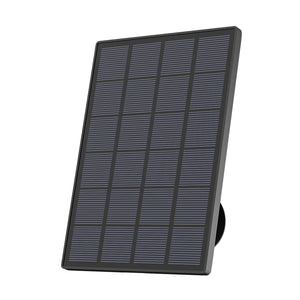
If Wi-Fi is available and you want a straightforward solar installation, the ieGeek S5 Solar Security Camera is one option for broad outdoor monitoring. The current UK product page describes 2.4GHz Wi-Fi, a detachable solar panel, 2K video and AI-assisted motion detection. It is better considered as a wide-angle solar security option than as a direct replacement for a long-range optical-zoom PTZ.
Frequently Asked Questions About Pan Tilt Zoom Cameras
What is a pan tilt zoom camera?
A pan tilt zoom camera is a motorised security camera that can move horizontally and vertically and, on models with optical zoom, magnify distant subjects through the lens. This allows one camera to observe different areas rather than remaining fixed on one viewpoint.
Can a PTZ camera see 360 degrees?
Some PTZ cameras can rotate continuously through 360 degrees horizontally, but that does not mean they can see every part of the surrounding environment at all times. Buildings, walls, trees and the camera's mounting position can still create physical blind spots.
Is optical zoom better than digital zoom for CCTV?
For long-distance security monitoring, optical zoom is generally more useful because magnification occurs through the lens rather than simply enlarging existing pixels. However, lens quality, sensor performance, lighting and distance still determine whether the resulting footage is useful for identification.
Can one PTZ camera replace several security cameras?
It can reduce the number of cameras needed for some large-area monitoring tasks, but it cannot watch several critical locations simultaneously. Fixed cameras are usually preferable for entrances and other areas requiring continuous coverage, with PTZ used as a flexible supplementary camera.
Are PTZ cameras suitable for outdoor use in the UK?
Yes, provided the camera is designed for the expected outdoor conditions and installed correctly. Check its IP rating, operating temperature, mounting position, power supply, connectivity and night performance rather than assuming every PTZ camera is suitable for exposed outdoor installation.
Conclusion
The best pan tilt zoom camera is not necessarily the one with the largest zoom number or widest advertised movement. The right choice depends on what needs to be monitored continuously, how far important subjects are from the camera, what happens after dark, and whether the site has reliable power and connectivity. These factors are also important when choosing the best CCTV camera for home use, as the right camera ultimately depends on the property and its specific monitoring needs.
For a large driveway, farm, commercial yard or warehouse, PTZ can provide valuable flexibility. For doors, gates and other critical points, fixed cameras may offer more dependable continuous coverage. In many real installations, combining both approaches produces a more balanced system.
Author Intro
 |
Developed by the ieGeek content team, combining hands-on experience with smart devices and insights into real user needs. ieGeek is widely known for smart security, our solutions are also designed for a variety of real-life scenarios, including travel, outdoor monitoring, pet care, and family safety. We focus on delivering simple, dependable solutions that fit seamlessly into daily life. |